Liquid metal vs thermal paste: when the swap is worth the risk
Every few months someone asks whether they should replace the paste under their cooler with liquid metal. The honest answer is usually no, and occasionally a very clear yes. It depends less on the stuff in the syringe than on where it goes: under a lid, on a bare die, or on top of a heat spreader where it has little to fix.
Here is what liquid metal is, what the maker figures do and do not mean, where it has earned its place, and how to keep it from wandering off and shorting something.
What liquid metal is
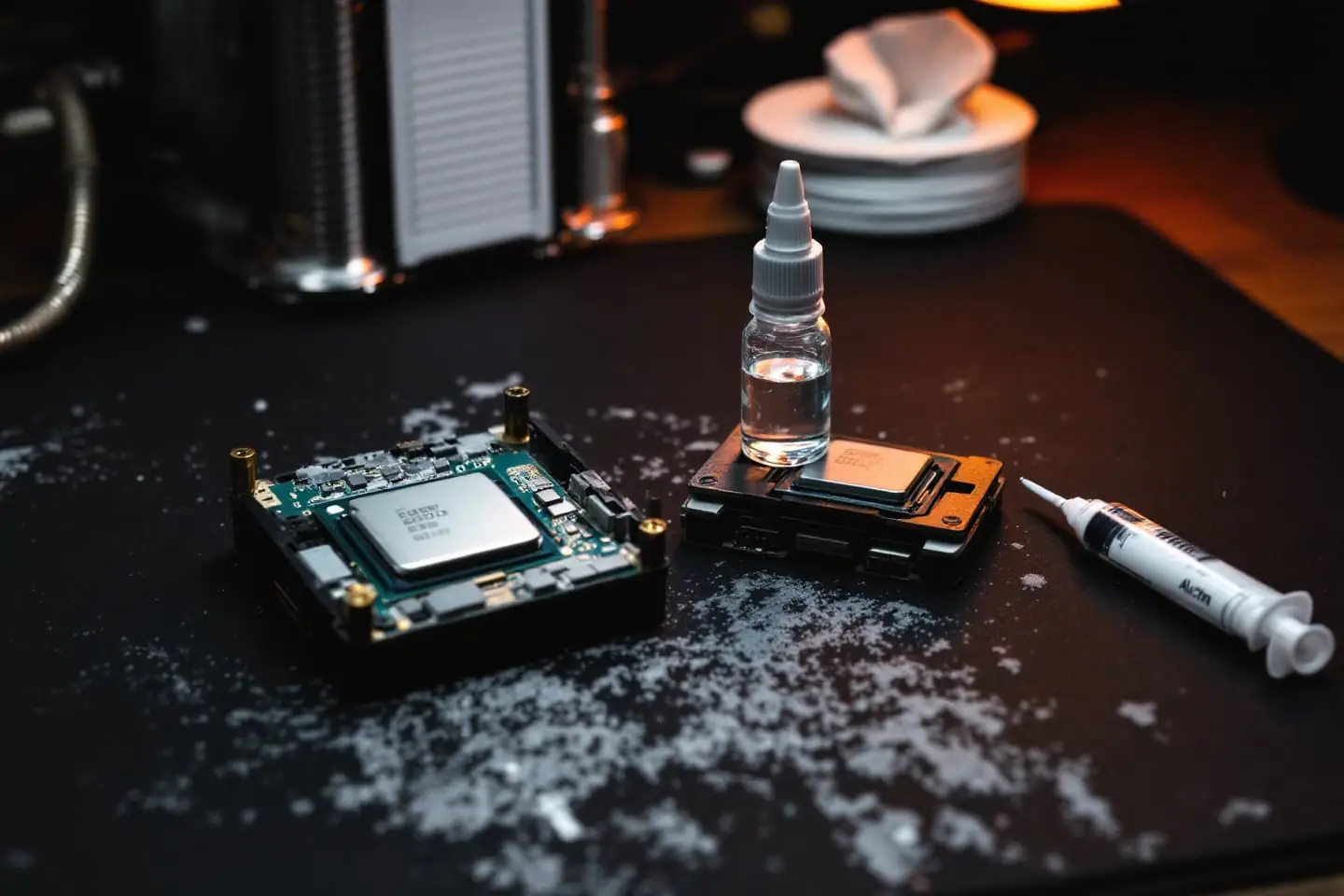
Liquid metal thermal compounds are alloys based on gallium, usually mixed with indium and tin, that stay liquid at room temperature. Thermal Grizzly describes its Conductonaut as a eutectic alloy of tin, gallium and indium among other metals. The related alloy galinstan (gallium, indium, tin) melts around minus 19 °C. Unlike mercury, these alloys wet and cling to many surfaces, glass included, which is why a swab can paint them into a film, and their toxicity is low (Thermal Grizzly still says to keep it off skin and out of eyes).
Two properties make it attractive. It has no solid filler particles, so it can form a film much thinner than any paste. And metals conduct heat far better than the silicone oil that carries the particles in a normal paste. The same properties make it dangerous: it conducts electricity, it flows, and gallium forms alloys with most metals it touches.
It is also heavy. Thermal Grizzly lists Conductonaut at 6.24 g/cm³, against 3.7 g/cm³ for its Kryonaut paste and 2.6 g/cm³ for Arctic's MX-6. A fingertip-sized blob weighs more than you expect and runs faster than you expect.
The conductivity numbers, and why they do not compare
You will see watts per meter-kelvin (W/mK) quoted everywhere. In 2018, Thermal Grizzly's product page listed Conductonaut at 73 W/mK. Its current data sheet gives density, viscosity and temperature range but no conductivity figure at all, and the company now says it has not published general W/(m·K) ratings since the end of 2020, because the test method, temperature, mounting pressure and contact surfaces all change the result. Arctic's MX-6 page likewise points to thermal resistance and bond line thickness (how thin the layer ends up) rather than printing a single conductivity value.
So treat any number on a box as a maker figure measured the maker's way. Two brands' figures are not comparable, and even one brand's figures across years may not be. For reference, the Wikipedia article on galinstan gives about 16.5 W/mK for that alloy, which shows how far apart quoted figures for similar metals can be.
What matters in a PC is the temperature difference across the whole joint, and that depends as much on how thin and complete the layer is as on the material.
Where it makes sense
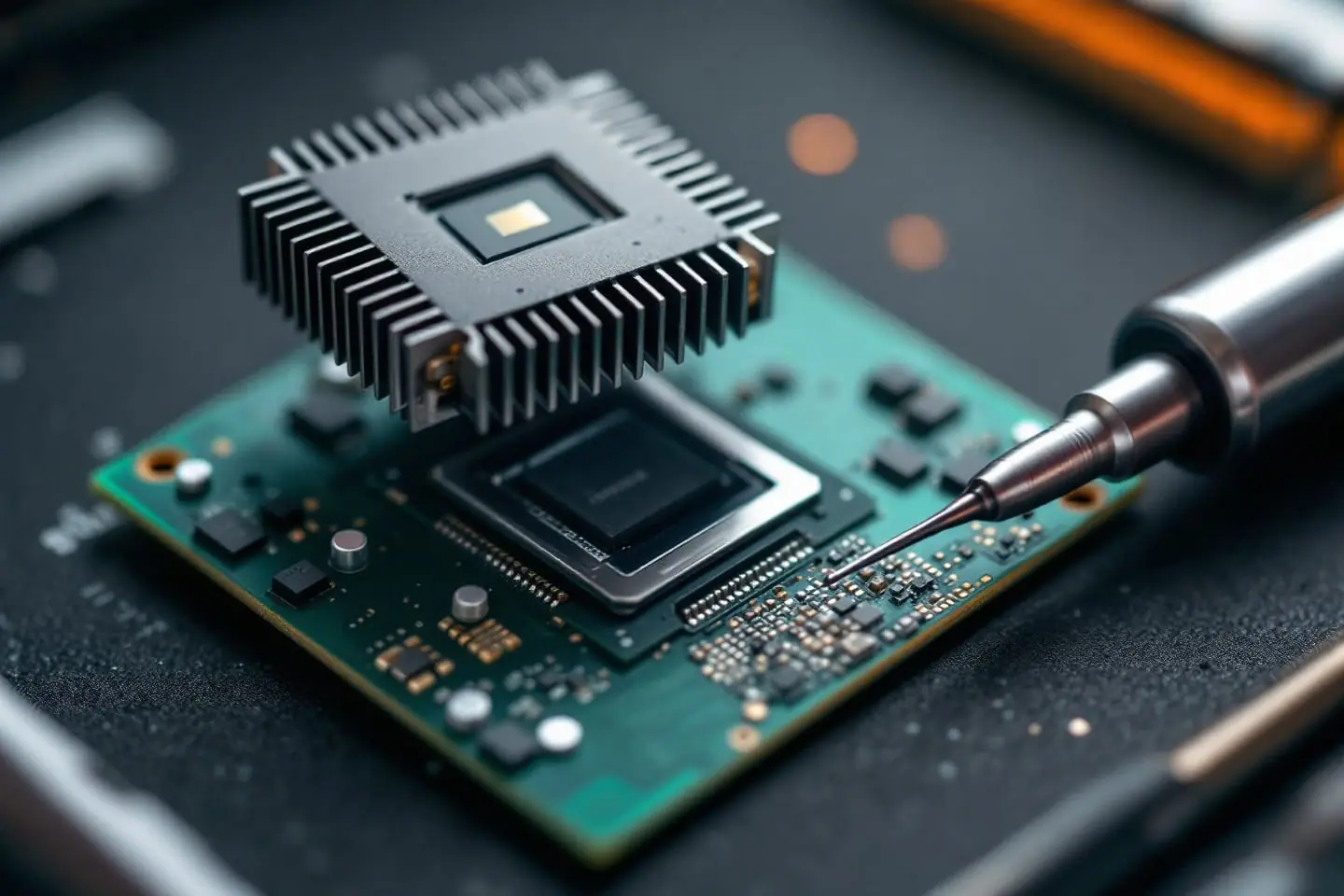
The best case is the one delidders discovered: the gap between a die and its heat spreader on Intel chips that shipped with paste there. The gap is tiny, it sits right on top of a small, very hot die, and the factory paste was the bottleneck. Our guide to delidding an Intel CPU shows the published numbers, which run from about 10 to 24 degrees depending on clocks and voltage.
The second good case is a bare die with a cooler designed for liquid metal. Two big manufacturers have done this at scale:
- ASUS announced in April 2020 that its whole 2020 range of ROG gaming laptops with 10th gen Intel Core processors would ship with Conductonaut applied by machine. ASUS reported 10 to 20 °C lower temperatures in its own testing, depending on the CPU, and described a custom sponge barrier around the die to stop the metal escaping.
- Sony's official PlayStation 5 teardown, covered by Ars Technica in October 2020, showed a liquid metal thermal interface on the main chip, which Sony said it had tested for two years before committing.
Both used controlled factory processes, copper or nickel-plated contact surfaces and containment that a home builder does not get with a syringe and a swab.
On top of a heat spreader, the gain is usually small. The lid has already spread the heat across a wide area, so the joint under the cooler is rarely the bottleneck. You take on all the risk for a small return.
Where it is a bad idea
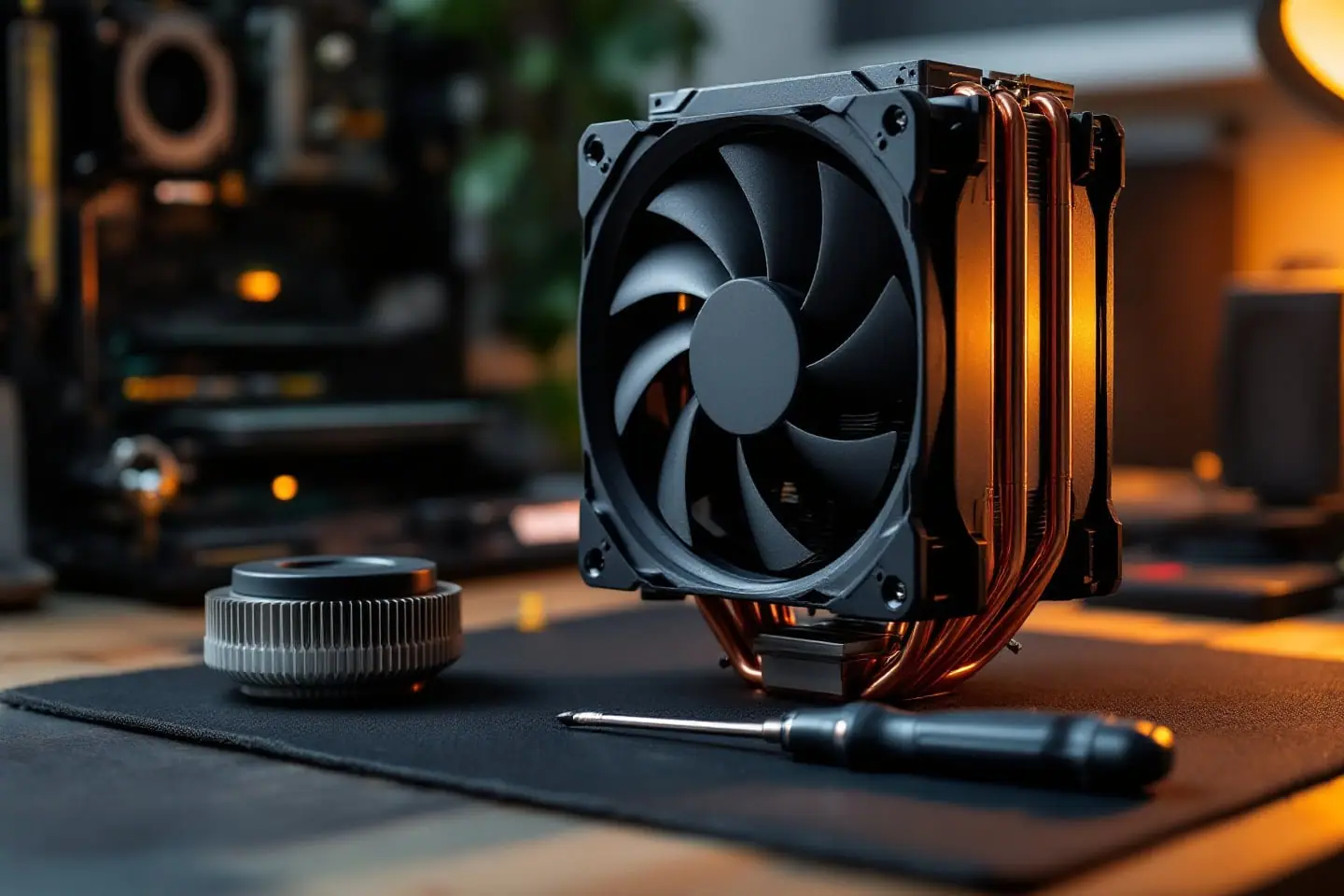
- Any aluminium in contact. Thermal Grizzly's guide says contact with aluminium permanently damages the cooler. That rules out many budget heatsinks, and coolers whose heat pipes touch the CPU directly are only safe if the base is copper.
- First-time builders. A paste mistake costs a cleanup. A liquid metal mistake can cost a motherboard.
- Laptops without containment. A laptop that lives on its edge in a bag, or one that runs hot and cools down twice a day, gives the metal gravity and thermal cycling to work with. ASUS built its sponge barrier to stop the metal seeping out onto nearby circuitry. Without one, the metal can creep toward the components around the die.
- Chips with components packed around the die. ASUS noted that Intel mobile CPUs have a clear zone around the die, while other processors put surface-mounted parts right where a spill would land.
- Anything you plan to sell or return. Gallium can stain copper and the printing on a heat spreader for good, and Thermal Grizzly warns that this can affect the maker's warranty.
Applying it and keeping it where it belongs
The procedure below follows Thermal Grizzly's quick guide, with the masking steps that builders commonly add. The masking is community practice, not something CPU makers document.
- Work above about 8 °C. Thermal Grizzly gives that as the lowest application temperature and suggests warming the syringe to at least 25 °C if it has been cold.
- Clean both surfaces with 99 percent isopropyl alcohol and lint-free wipes until a fresh wipe comes away clean. Let them dry fully.
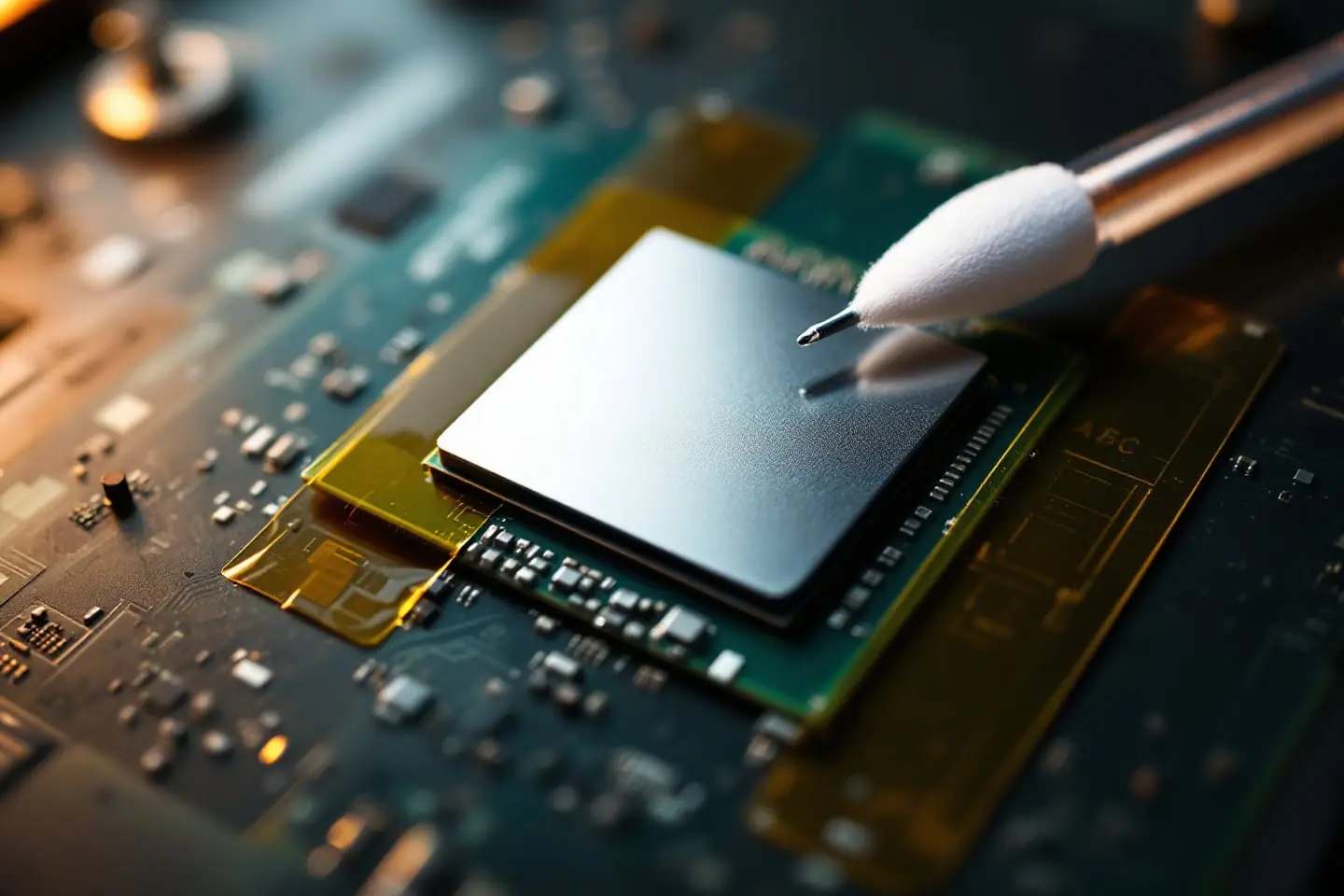
- Mask the area around the die with polyimide (Kapton) tape so only the die and a millimeter of margin show.
- Cover any exposed capacitors or resistors near the die with a thin coat of clear nail polish or a conformal coating, and let it cure completely.
- Put a pinhead-sized drop on the die and another on the matching spot of the cooler or lid. Less than you think.
- Spread each drop with a cotton swab or brush until the surface has an even, mirror-like coat with no bare patches. Use the plastic needle to draw any excess back into the syringe.
- Check the edges under a bright light for beads before you close anything up.
- Mount the cooler or lid straight down, without sliding it across the die.
We list these from makers' specifications and published reviews, not from hands-on testing of our own. The rest of the bench basics are in the parts bin.
How it ages
Paste ages by pumping out (thermal cycling slowly pushes it from the joint) and, on cheaper compounds, by drying. Liquid metal ages differently. Gallium alloys with bare copper, so on an uncoated copper cold plate part of the layer is slowly absorbed into the surface. Owners commonly report a dull, grey, dry-looking film after a while, a stained cold plate and temperatures creeping back up, cured by cleaning and applying a fresh, thin layer. Thermal Grizzly recommends nickel-plated surfaces for the best long-term stability, and the usual explanation is that nickel resists this alloying far better than raw copper.
Aluminium is worse than either. Gallium works into the grain boundaries of the metal and makes it brittle, a process called liquid metal embrittlement. That is why the warning about aluminium is absolute rather than a matter of performance.
Side by side
| Liquid metal | Non-conductive paste | |
|---|---|---|
| Base | Gallium alloy with indium and tin | Silicone oil or similar carrier with fine particles |
| Conducts electricity | Yes | No, on the products named here |
| Safe with aluminium | No | Yes |
| Density (maker figures) | 6.24 g/cm³ (Conductonaut) | 3.7 g/cm³ (Kryonaut), 2.6 g/cm³ (MX-6) |
| Layer | Very thin film | Thicker; not for gaps above about 0.2 mm |
| Best use | Under the lid of a paste-era delidded chip, or a bare die with containment | Everyday CPU and GPU coolers |
| Typical gain on top of a lid | Small | Baseline |
| How it ages | Alloys into bare copper, may need redoing | Pump-out over time |
| Cleanup | Swabs and cleaning pads, may stain | Alcohol and a wipe |
| Beginner friendly | No | Yes |
Quick answers
Should I put liquid metal on top of my CPU's heat spreader?
Usually not. The lid is nickel-plated copper and can take it, but the gain over a good paste is small, and your cooler's base must not be aluminium. Spend the effort on a better cooler or better case airflow.
Does liquid metal dry out?
It does not evaporate like a cheap paste, but it can look dry when gallium has been absorbed into bare copper. Plan on checking temperatures under a repeatable load now and then, and redo it if they creep up.
Is it worth it on an old LGA 775 overclock?
Rarely. On a Core 2 or a modded Xeon the limit is usually the cooler and the board's power delivery, not the interface under the cooler, and many older coolers have aluminium bases. Our notes on overclocking a Xeon on an LGA 775 board and the cooler TDP headroom check are a better place to start. A good paste is the sensible choice there.
Sources and further reading
- Thermal Grizzly, Conductonaut product page, data sheet and quick start guide (composition, density, application temperature, aluminium warning, nickel recommendation)
- Thermal Grizzly, Conductonaut product page as archived in January 2018 (the 73 W/mK figure)
- Thermal Grizzly, Kryonaut product page and FAQ (density, pump-out, why the company no longer publishes W/(m·K) ratings)
- Arctic, MX-6 product page (density, electrical properties, thermal resistance and bond line thickness)
- ASUS Republic of Gamers, Our patented process brings exotic liquid metal thermal compound to new ROG gaming laptops (April 2, 2020)
- Ars Technica, The first PlayStation 5 teardown reveals some hardware secrets (October 7, 2020)
- Wikipedia, Galinstan and Gallium (background on the alloy and on liquid metal embrittlement)

Devin handles cooling: thermal paste, pads, delidding and liquid metal. He explains where the heat goes in plain numbers and is suspicious of any cooler box that prints a wattage without saying how it was measured.