Sizing a CPU cooler by TDP: what the watt ratings do and do not tell you
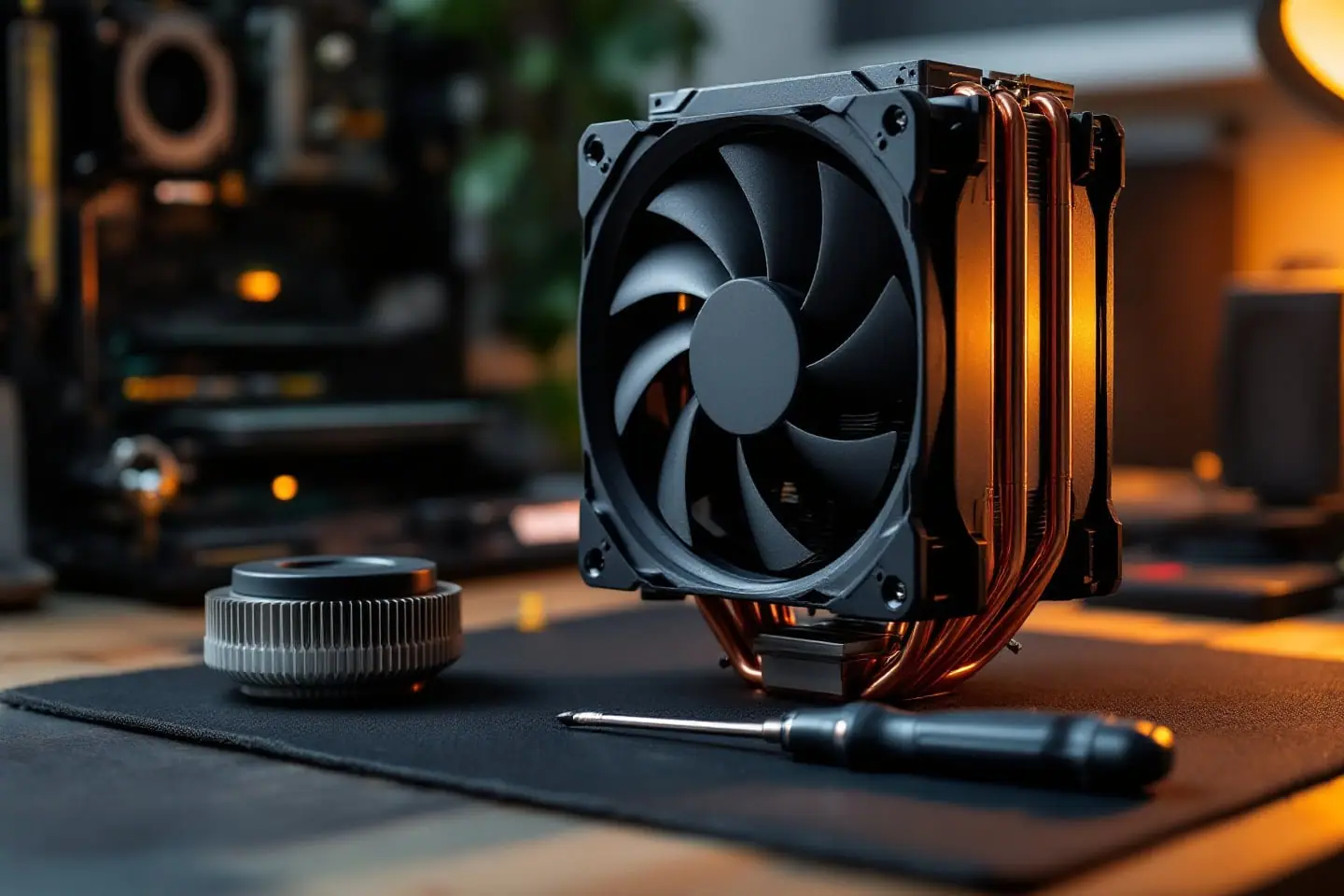
The CPU box says 125 W. The cooler box says it handles 250 W. It looks like simple arithmetic with plenty to spare, and it often is not. The two numbers are measured by different companies, under different assumptions, and neither of them is the power your chip actually draws when you render a video.
This piece explains what the processor makers mean by TDP, why cooler ratings cannot be compared, what really decides how hot a chip runs, and how to size a cooler, including for an old Xeon on an LGA 775 board and for an overclock.
What TDP means on an Intel chip
TDP stands for thermal design power. Intel's own support article describes it as a power target for system designers, the figure a thermal solution should be designed around, and notes that during turbo the chip can exceed it for a limited time until it reaches a temperature or power delivery limit. That last clause is where most of the confusion comes from.
From the 12th generation (2021) on, Intel replaced the term. Its product pages now list two figures:
- Processor Base Power (PBP): the old TDP under a new name, the sustained power the chip is specified around at base clocks.
- Maximum Turbo Power (MTP): the most the chip will draw for more than about a second when turbo is allowed to run, as limited by its current and temperature controls.
In the BIOS these appear as power limits: PL1, the long-duration limit, and PL2, the short-duration limit. Take the Core i9-12900K. Intel lists it at 125 W base power and 241 W maximum turbo power. Many desktop boards set PL1 and PL2 both to the higher figure out of the box, so a long all-core load can hold the chip near 241 W for as long as the load lasts. A cooler sized for "125 W" is then being asked to move nearly twice that. Board makers do not all ship the same defaults for the same chip, so check what yours sets before you shop.
What TDP means on an AMD chip
AMD defines TDP with a cooling formula rather than a power measurement. Gamers Nexus published it in 2019 with figures supplied by AMD:
TDP (W) = (tCase - tAmbient) / theta_ca

tCase     = highest heat spreader (case) temperature allowed for rated performance, °C
tAmbient  = air temperature at the cooler's intake, °C
theta_ca  = cooler's thermal resistance, case to ambient, °C per watt
For the Ryzen 9 3900X, AMD's values were a tCase of 61.8 °C, an ambient of 42 °C and a theta of 0.189 °C/W:
(61.8 - 42) / 0.189 = 19.8 / 0.189 = 104.76 W, rounded to 105 W
Two things stand out. The ambient is 42 °C, which AMD described as the air at the cooler's inlet inside the case, not the room. And nowhere does electrical power appear: the formula describes a cooler, not the chip's draw. The chip's actual limit is a separate figure, Package Power Tracking (PPT). AMD's own example, quoted in the same article, had the 105 W part boosting until it reached 61.8 °C at the lid or 142 W of PPT, whichever came first.
Why cooler watt ratings are not a standard
A cooler maker's "rated for 200 W" has no shared test behind it. To rate a cooler you have to choose a heat source, a fan speed, an air temperature and the maximum temperature you will accept, and every maker picks its own. A rating at full fan speed in a cool lab and a rating at a quiet fan speed in a warm case can describe the same heatsink.
Gamers Nexus spoke to three major cooler makers for the same 2019 piece, and the conclusion was blunt: buying a 95 W chip and a 95 W cooler does not mean they are matched, and many cooler makers had moved away from watt ratings toward per-CPU compatibility lists. That list is still the better guide. Treat the watt figure on the box as a rough size class, comparable only within one maker's range.
What actually decides how hot the chip runs
Power is only the start. The temperature you see depends on how easily that power gets out:
| Factor | Why it matters |
|---|---|
| Heat density | A small die making 150 W is far harder to cool than a large die making the same power. Modern chips concentrate heat in small hot spots. |
| Under the lid | Solder or paste between die and heat spreader sets a floor no cooler can get under. Delidding exists because of this (see our delid guide). |
| The paste joint | A dry, thick or patchy layer adds degrees at every load. A proper repaste is the simplest fix there is. |
| Fan curve | The same heatsink moves far more heat at full fan speed than at a whisper. A rating quoted at full speed tells you little about a quiet build. |
| Case airflow | The cooler can only work with the air it is given. AMD's own formula assumes 42 °C intake air. |
| Room temperature | Every degree warmer in the room is roughly a degree warmer at the CPU. Summer matters. |
Old chips on stock coolers
Older hardware is where TDP numbers are easiest to read, because chips like the 45 nm Xeons had no turbo to push past the rating. It is also where people get caught out.
Intel's boxed coolers were sized for the chip in the box: the Core 2 Quad Q9650, rated at 95 W, was sold in a boxed version with its own cooler built for that rating. Put an 80 W Xeon E5450 on that cooler through the LGA 771 to 775 mod and you have some margin at stock. Put a 120 W X5470 on it and you are asking a 95 W design to move 25 W more, before any overclock, often with old paste and a dusty heatsink. The usual results are high temperatures under load, a fan at full speed and throttling.
The board matters as much as the cooler. Many LGA 775 boards were never specified for 120 W chips, and their voltage regulators run hot without airflow. Page 2 of the LGA 771 to 775 guide covers TDP and VRM limits by chipset. If you plan a 120 W Xeon, budget for a real tower cooler with an LGA 775 mount and some air over the board's power stage.
Overclocking: why heat climbs faster than clocks
The part of a CPU's power that comes from switching transistors scales roughly with frequency times voltage squared. Clock speed counts once; voltage counts twice. Leakage current comes on top of that and grows as the chip gets hotter, so treat any estimate as a floor rather than a ceiling.
Here is a worked example, using the same inputs as our cooler TDP headroom check starts with. Say you have an 80 W Xeon running at 3.0 GHz with a stock core voltage of 1.20 V, and you want 3.6 GHz (a 400 MHz FSB times a multiplier of 9), which needs 1.30 V on your chip.
Frequency factor: 3.6 / 3.0           = 1.200
Voltage factor:   (1.30 / 1.20) ^ 2   = 1.174
Combined scale:   1.200 x 1.174       = 1.408
Estimated heat:   80 W x 1.408        = about 113 W
A 20 percent clock bump brought about 41 percent more heat with it. Against a cooler rated at 150 W, that is a ratio of about 1.33, which the tool calls workable headroom. Now suppose your chip needs 1.35 V instead:
Voltage factor:   (1.35 / 1.20) ^ 2   = 1.266
Combined scale:   1.200 x 1.266       = 1.519
Estimated heat:   80 W x 1.519        = about 122 W
Another 0.05 V took the 80 W chip past a stock X5470's rating. Overclocking a Xeon on a Core 2 board has its own limits (straps, board voltages); our LGA 775 Xeon overclocking guide covers those.
How to choose
- Find the real sustained power. For Intel 12th gen and later, use Maximum Turbo Power if your board runs without limits; for AMD, use PPT; for an overclock, estimate it as above.
- Look up the cooler maker's compatibility list for your exact CPU. Use the watt rating only to compare models from the same maker.
- Check the mount for your socket, the cooler height against your case, and clearance over tall memory.
- Leave headroom. A cooler that only just matches the estimate runs its fans flat out. Something 20 to 50 percent above your estimate is a comfortable target; that is the band the headroom tool calls workable.
- Think about noise. A larger cooler at a slow fan speed often beats a small one at full speed on both temperature and sound.
- Fix the airflow. Give the case at least one intake and one exhaust before you blame the cooler.
These parts come from makers' specifications and published reviews; none of them has been through hands-on testing of our own.
If the numbers still look tight after all that, the answer is usually a step down in voltage rather than a step up in cooler. Drop the target clock by 100 or 200 MHz, rerun the estimate, and see how much heat disappears.
Sources and further reading
- Intel, Thermal Design Power (TDP) in Intel Processors (support article; TDP as a design target, the change to Processor Base Power from 12th gen)
- Intel, Core i9-12900K specifications (Processor Base Power and Maximum Turbo Power)
- Gamers Nexus, AMD Ryzen TDP Explained: Deep-Dive on TDP Definitions and What Cooler Manufacturers Think (October 20, 2019)
- Wikipedia, Processor power dissipation (dynamic power and leakage)
- Wikipedia, Alder Lake (Intel's Maximum Turbo Power definition as quoted from its specifications)
- Wikipedia, List of Intel Xeon processors (Core-based) and List of Intel Core 2 processors (TDP, clocks and voltage ranges for the E5450, X5470 and Q9650)

Devin handles cooling: thermal paste, pads, delidding and liquid metal. He explains where the heat goes in plain numbers and is suspicious of any cooler box that prints a wattage without saying how it was measured.