Intel Core 2 Quad and Core 2 Extreme CPUs: the LGA 775 quad lineup
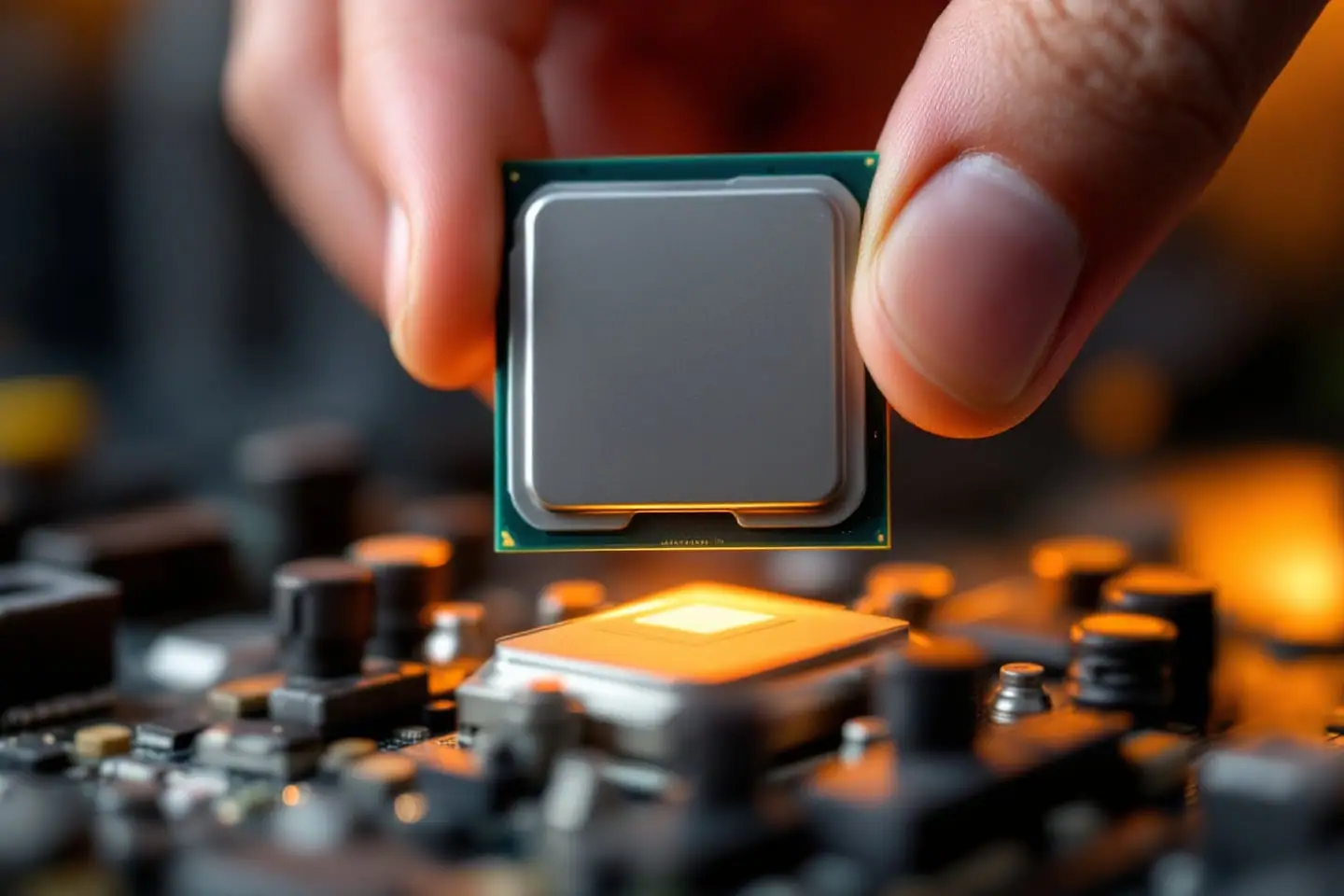
Intel's desktop quad-core line opened in November 2006 with the Core 2 Extreme QX6700 and closed with the Core 2 Quad Q9500, launched in January 2010. Every chip in between is two dual-core dies under one heat spreader, and all but one use the same LGA 775 socket as the Core 2 Duo.
The table also carries the Xeon 3200 and 3300 quads (X3210 to X3380, plus the L3360). They are the same silicon sold for single-socket servers, on the same socket, so the Mod column reads "native" for them too: no adapter, just a chipset and BIOS that list the chip. One row reads "adapter", and it is not a Xeon. The Core 2 Extreme QX9775 is an LGA 771 part, covered further down.
| Model | Socket | Cores | Clock (GHz) | FSB (MT/s) | L2 cache | TDP (W) | Process | Codename | Mod |
|---|---|---|---|---|---|---|---|---|---|
| Core 2 Extreme QX9770 | LGA 775 | 4 | 3.2 | 1600 | 12 MB (2 x 6 MB) | 136 | 45 nm | Yorkfield | Native |
| Core 2 Extreme QX9775 | LGA 771 | 4 | 3.2 | 1600 | 12 MB (2 x 6 MB) | 150 | 45 nm | Yorkfield | Adapter |
| Xeon X3380 | LGA 775 | 4 | 3.16 | 1333 | 12 MB (2 x 6 MB) | 95 | 45 nm | Yorkfield | Native |
| Core 2 Extreme QX6850 | LGA 775 | 4 | 3.0 | 1333 | 8 MB (2 x 4 MB) | 130 | 65 nm | Kentsfield | Native |
| Core 2 Extreme QX9650 | LGA 775 | 4 | 3.0 | 1333 | 12 MB (2 x 6 MB) | 130 | 45 nm | Yorkfield | Native |
| Core 2 Quad Q9650 | LGA 775 | 4 | 3.0 | 1333 | 12 MB (2 x 6 MB) | 95 | 45 nm | Yorkfield | Native |
| Xeon X3370 | LGA 775 | 4 | 3.0 | 1333 | 12 MB (2 x 6 MB) | 95 | 45 nm | Yorkfield | Native |
| Core 2 Extreme QX6800 | LGA 775 | 4 | 2.93 | 1066 | 8 MB (2 x 4 MB) | 130 | 65 nm | Kentsfield | Native |
| Core 2 Quad Q9500 | LGA 775 | 4 | 2.83 | 1333 | 6 MB (2 x 3 MB) | 95 | 45 nm | Yorkfield | Native |
| Core 2 Quad Q9505 | LGA 775 | 4 | 2.83 | 1333 | 6 MB (2 x 3 MB) | 95 | 45 nm | Yorkfield | Native |
| Core 2 Quad Q9505S | LGA 775 | 4 | 2.83 | 1333 | 6 MB (2 x 3 MB) | 65 | 45 nm | Yorkfield | Native |
| Core 2 Quad Q9550 | LGA 775 | 4 | 2.83 | 1333 | 12 MB (2 x 6 MB) | 95 | 45 nm | Yorkfield | Native |
| Core 2 Quad Q9550S | LGA 775 | 4 | 2.83 | 1333 | 12 MB (2 x 6 MB) | 65 | 45 nm | Yorkfield | Native |
| Xeon L3360 | LGA 775 | 4 | 2.83 | 1333 | 12 MB (2 x 6 MB) | 65 | 45 nm | Yorkfield | Native |
| Xeon X3360 | LGA 775 | 4 | 2.83 | 1333 | 12 MB (2 x 6 MB) | 95 | 45 nm | Yorkfield | Native |
| Core 2 Quad Q8400 | LGA 775 | 4 | 2.66 | 1333 | 4 MB (2 x 2 MB) | 95 | 45 nm | Yorkfield | Native |
| Core 2 Quad Q8400S | LGA 775 | 4 | 2.66 | 1333 | 4 MB (2 x 2 MB) | 65 | 45 nm | Yorkfield | Native |
| Core 2 Quad Q9400 | LGA 775 | 4 | 2.66 | 1333 | 6 MB (2 x 3 MB) | 95 | 45 nm | Yorkfield | Native |
| Core 2 Quad Q9400S | LGA 775 | 4 | 2.66 | 1333 | 6 MB (2 x 3 MB) | 65 | 45 nm | Yorkfield | Native |
| Core 2 Quad Q9450 | LGA 775 | 4 | 2.66 | 1333 | 12 MB (2 x 6 MB) | 95 | 45 nm | Yorkfield | Native |
| Xeon X3330 | LGA 775 | 4 | 2.66 | 1333 | 6 MB (2 x 3 MB) | 95 | 45 nm | Yorkfield | Native |
| Xeon X3350 | LGA 775 | 4 | 2.66 | 1333 | 12 MB (2 x 6 MB) | 95 | 45 nm | Yorkfield | Native |
| Core 2 Extreme QX6700 | LGA 775 | 4 | 2.66 | 1066 | 8 MB (2 x 4 MB) | 130 | 65 nm | Kentsfield | Native |
| Core 2 Quad Q6700 | LGA 775 | 4 | 2.66 | 1066 | 8 MB (2 x 4 MB) | 95 | 65 nm | Kentsfield | Native |
| Xeon X3230 | LGA 775 | 4 | 2.66 | 1066 | 8 MB (2 x 4 MB) | 95 | 65 nm | Kentsfield | Native |
| Core 2 Quad Q8300 | LGA 775 | 4 | 2.5 | 1333 | 4 MB (2 x 2 MB) | 95 | 45 nm | Yorkfield | Native |
| Core 2 Quad Q9300 | LGA 775 | 4 | 2.5 | 1333 | 6 MB (2 x 3 MB) | 95 | 45 nm | Yorkfield | Native |
| Xeon X3320 | LGA 775 | 4 | 2.5 | 1333 | 6 MB (2 x 3 MB) | 95 | 45 nm | Yorkfield | Native |
| Core 2 Quad Q6600 | LGA 775 | 4 | 2.4 | 1066 | 8 MB (2 x 4 MB) | 105 | 65 nm | Kentsfield | Native |
| Xeon X3220 | LGA 775 | 4 | 2.4 | 1066 | 8 MB (2 x 4 MB) | 105 | 65 nm | Kentsfield | Native |
| Core 2 Quad Q8200 | LGA 775 | 4 | 2.33 | 1333 | 4 MB (2 x 2 MB) | 95 | 45 nm | Yorkfield | Native |
| Core 2 Quad Q8200S | LGA 775 | 4 | 2.33 | 1333 | 4 MB (2 x 2 MB) | 65 | 45 nm | Yorkfield | Native |
| Xeon X3210 | LGA 775 | 4 | 2.13 | 1066 | 8 MB (2 x 4 MB) | 105 | 65 nm | Kentsfield | Native |
Two generations at a glance
| Kentsfield | Yorkfield-6M | Yorkfield | |
|---|---|---|---|
| Process | 65 nm | 45 nm | 45 nm |
| L2 cache | 8 MB | 4 MB or 6 MB | 12 MB |
| FSB (MT/s) | 1066 (QX6850: 1333) | 1333 | 1333 (QX9770, QX9775: 1600) |
| SSE4.1 | no | yes | yes |
| Core 2 Quad | Q6600, Q6700 | Q8200 to Q8400, Q9300 to Q9505 | Q9450, Q9550, Q9650 |
| Core 2 Extreme | QX6700, QX6800, QX6850 | none | QX9650, QX9770, QX9775 |
| Xeon on LGA 775 | X3210, X3220, X3230 | X3320, X3330 | X3350 to X3380, L3360 |
| Steppings | B3, G0 | M0, M1, R0 | C0, C1, E0 |
Clock is bus clock times multiplier, so the bus column explains a lot. A 1066 MT/s bus runs at 266 MHz: the Q6600 is 266 x 9 = 2.4 GHz. A 1333 MT/s bus runs at 333 MHz: the Q9650 is 333 x 9 = 3.0 GHz. The QX9770 reaches 3.2 GHz on a 400 MHz (1600 MT/s) bus with an 8x multiplier. Whether your board runs that 1600 bus is a chipset and BIOS question, which our support guide walks through.
Model-number traps
Is a Q9500 a cut-down Q9550?
In cache, yes. The Q9500 and Q9505 run at 2.83 GHz like the Q9550, but as Yorkfield-6M chips they carry 3 MB of L2 per die, 6 MB in all, against 12 MB. The same split separates the Q9400 (6 MB) from the Q9450 (12 MB), both at 2.66 GHz. The Q8200, Q8300 and Q8400 go further: only 2 MB per die is enabled, 4 MB in total.
Why do some Q8000 chips lack VT-x?
Intel left hardware virtualization out of several Q8000 sSpecs. Per Wikipedia's Core lists, the Q8200 lacks VT-x in every sSpec, while the Q8200S and Q8300 gained it in later sSpecs (SLGSS and SLGUR). If you plan to run a hypervisor, check the sSpec, not the model.
What does the S suffix mean?
A 65 W TDP class instead of 95 W, with the same clock, bus and cache: Q8200S, Q8400S, Q9400S, Q9505S and Q9550S. Intel aimed them at OEMs building small form factor machines. Wikipedia's Core list notes that the first Q9550S batch lacks the S on the lid, so the sSpec SLGAE is the reliable tell. Its server twin is the Xeon L3360: 2.83 GHz, 12 MB, 65 W.
Did the Q6600 have two TDPs?
Yes. The B3 stepping (SL9UM) is rated 105 W and the later G0 (SLACR) 95 W, at the same 2.4 GHz. Where Intel rated steppings differently, the chip's own page lists each sSpec.
The Extreme chips
Extreme models can raise their multiplier as well as lower it, so you can overclock them with the bus, chipset and memory left at stock. The 65 nm QX6700 (2.66 GHz), QX6800 (2.93 GHz) and QX6850 (3.0 GHz, the only Kentsfield on FSB 1333) are all rated 130 W. The 45 nm QX9650 matches the QX6850's clock and bus with 12 MB of cache at 130 W; the QX9770 goes to 3.2 GHz and FSB 1600 at 136 W. See the Core 2 Extreme archive for the individual pages.
The QX9775 is the exception: 3.2 GHz, FSB 1600, 12 MB and 150 W, built for dual-socket LGA 771 boards and closely related to the Xeon X5482, which has the same clock, bus, cache and TDP. On an LGA 775 board it needs the adapter mod like any LGA 771 Xeon, plus a board that handles its 1600 bus.
Xeon twins on LGA 775
Most 3200 and 3300 Xeons match a desktop chip in clock, bus and cache:
| Xeon | Core 2 Quad | Clock | L2 |
|---|---|---|---|
| X3220 | Q6600 | 2.4 GHz | 8 MB |
| X3230 | Q6700 | 2.66 GHz | 8 MB |
| X3320 | Q9300 | 2.5 GHz | 6 MB |
| X3330 | Q9400 | 2.66 GHz | 6 MB |
| X3350 | Q9450 | 2.66 GHz | 12 MB |
| X3360 | Q9550 | 2.83 GHz | 12 MB |
| X3370 | Q9650 | 3.0 GHz | 12 MB |
| L3360 | Q9550S | 2.83 GHz | 12 MB |
The X3210 (2.13 GHz) matches only the OEM-only Q6400, and the X3380 at 3.16 GHz (333 x 9.5) has no Core 2 Quad equivalent at all. Before you buy one, check the board maker's CPU support list for the Xeon model itself, not just its desktop twin. For a wider view that includes the LGA 771 Xeons, use the combined CPU table or the Core 2 Quad archive.
If a listing shows only a model number, ask for the sSpec. It settles the stepping, the TDP class and, on a Q8300, whether you get VT-x.

Marek writes the socket-mod and Xeon pages. He likes boards with too many jumpers, keeps a drawer of LGA 775 chips sorted by stepping, and reads Intel spec updates the way other people read box scores.